

Miri Technologies
Miri V410
The 4K encoder-decoder for streaming and video-over-IP workflows
The Miri V410 is a 4K video encoder-decoder for streaming and video-over-IP workflows. It handles NDI HX2 and HX3, NDI High Bandwidth decoding, SRT, RTMP/RTMPS, HLS, RTSP and TS over UDP, with HDMI, SDI and USB (UVC) inputs and outputs. One unit covers encoding, decoding and simulcasting to multiple platforms.
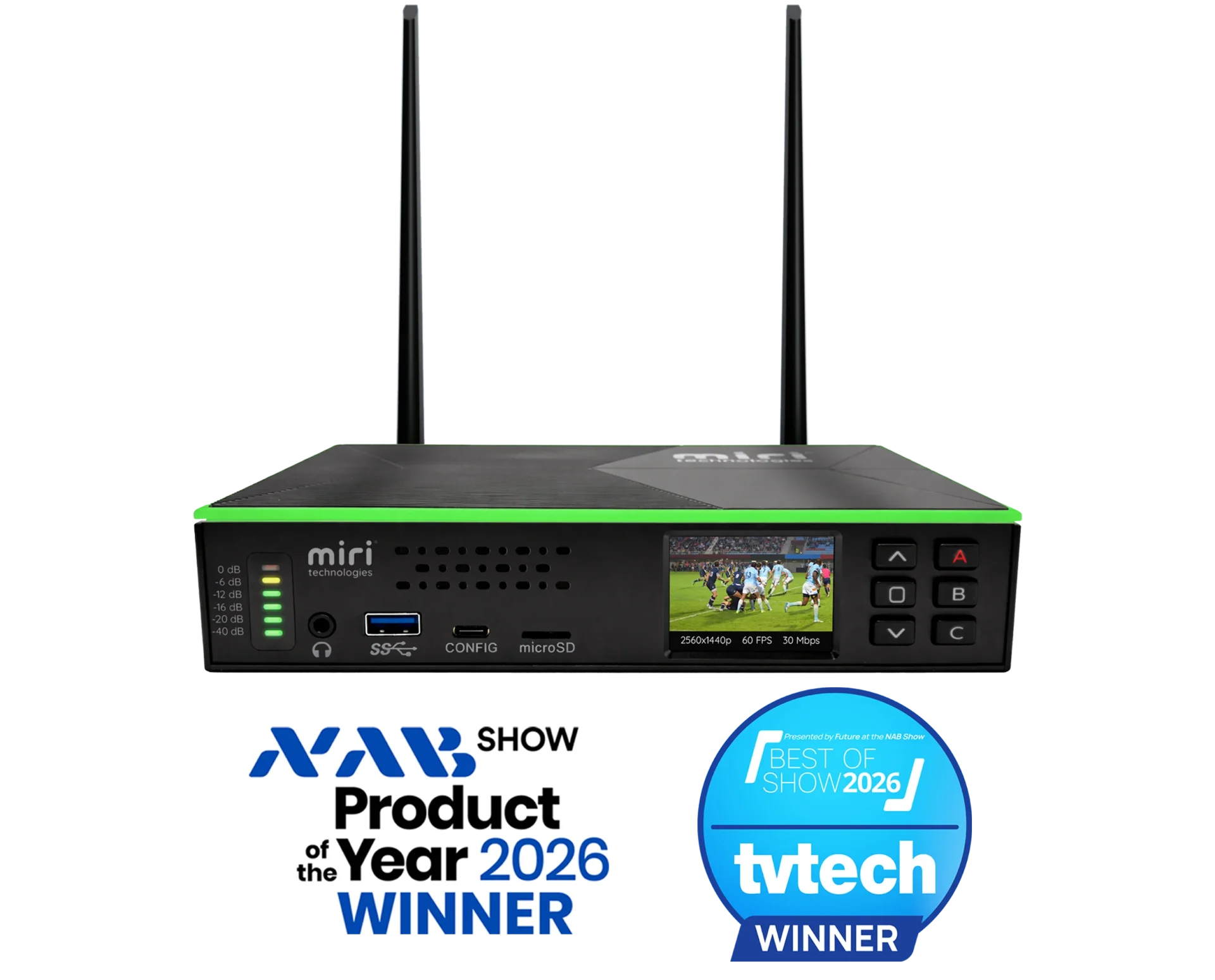
- HDMI 2.0 in and out
- 4K60
- simultaneous streaming destinations
- 8
- independent encodes up to 40 Mbps each
- 2
- plus 2 Gigabit Ethernet ports, one with PoE
- Wi-Fi 7
Encoder, decoder and gateway
The V410 plays three roles depending on stream direction. As an encoder, it turns an HDMI, SDI or UVC source into an IP stream (NDI HX, SRT, RTMP...). As a decoder, it does the opposite: an incoming IP stream comes out over HDMI, SDI or UVC to a switcher, monitor or software. In between, it bridges formats, for instance receiving an NDI feed and re-streaming it as SRT to a remote control room.
That versatility is what sets it apart from a plain streaming encoder: the same hardware serves field contribution, control-room reception and site-to-site interconnection.
Video inputs and outputs
The UVC output earns its keep in corporate settings: the decoded feed lands in Teams, Zoom or OBS like any webcam, no capture card required.
- HDMI 2.0: up to 4K Ultra HD (3840 × 2160) at 60 fps, both in and out
- 3G-SDI: up to 1080p60, both in and out
- USB (UVC): webcam input up to 1080p30, and a webcam output to a computer, the V410 showing up as a standard USB camera
Codecs and transport protocols
Encoding relies on H.264 (Baseline/Main/High profiles, level 5.2) and H.265/HEVC (Main profile, level 5.1). On the transport side, the V410 speaks SRT, RTMP and RTMPS, HLS, RTSP and TS over UDP: from secured contribution over the public internet to distribution on a managed local network.
To pick the right protocol for the job (latency, reliability, platform compatibility), the full comparison lives on the transport protocols guide.
NDI HX2, HX3, High Bandwidth and NDI Bridge
The V410 encodes and decodes NDI HX2 and HX3, the compressed NDI variants suited to standard networks. On the decode side it also accepts NDI High Bandwidth (the lightly compressed studio flavour) and the OMT format.
Built-in NDI Bridge support lets the V410 take part in a site-to-site NDI workflow directly, without running NDI Bridge on a separate computer at the V410 end. An NDI studio can receive a remote feed as if it were on the local network.
The basics of NDI and its variants are covered on the NDI guide.
Simultaneous processing and simulcasting
The V410 runs two independent encodes, each with its own parameters, up to 40 Mbps per stream: for instance a high-quality feed to the control room and a lighter one to a public platform. Simulcasting reaches 8 platforms at once.
On the decode side, up to two streams are handled simultaneously, with capacity reaching 4K60 depending on format, codec and the output in use (the SDI output tops out at 1080p60).
Recording, graphics and monitoring
Recording
Local recording to microSD card or external USB storage, in parallel with streaming: a safety copy of the live feed with no extra equipment.
Graphics and scheduling
Up to 8 text or image overlays burned in at encode time, plus scheduled streams and recordings for recurring broadcasts with no operator on site.
Monitoring
An API for integration into control-room automation, and SNMP for network monitoring. Connectivity: 2 Gigabit Ethernet ports (one with PoE) and Wi-Fi 7.
Where the V410 makes the difference
Multi-destination streaming
Conferences, trade shows, corporate events: the V410 encodes once and streams simultaneously to YouTube, LinkedIn, an internal CDN and a remote control room.
Field-to-control-room contribution
An SDI/HDMI camera in the field, the V410 sending NDI HX3 or SRT, centralised reception in vMix, OBS or a software switcher: a complete contribution chain on a controlled budget.
Interconnecting NDI studios
A remote NDI feed enters the studio through the built-in NDI Bridge support and behaves like a local source: no server to deploy at the V410 end.
Permanently equipped venues
A fixed encoder wired into the video system of a performance hall or place of worship, streams scheduled every week, local recording running alongside.
V410 and X510: the contribution duo
The V410 handles the video, the X510 secures and aggregates the internet connection that carries it. The camera feeds the V410, which encodes; the stream crosses the local network to the X510, which sends it over its combined connections (5G, 4G, Ethernet, satellite) to its destination.
The V410 also works without the X510 when the available connection is already stable enough. Together they deliver an integrated video-processing and internet-transport package.
Key specifications
| Video inputs | HDMI 2.0 (4K60), 3G-SDI (1080p60), USB UVC (1080p30) |
|---|---|
| Video outputs | HDMI 2.0 (4K60), 3G-SDI (1080p60), UVC webcam output |
| Codecs | H.264 Baseline/Main/High level 5.2 · H.265/HEVC Main level 5.1 |
| NDI | NDI HX2/HX3 encode and decode · NDI High Bandwidth and OMT decode · built-in NDI Bridge support |
| Protocols | SRT, RTMP/RTMPS, HLS, RTSP, TS over UDP |
| Simultaneous encoding | 2 independent streams up to 40 Mbps each · simulcast to 8 platforms |
| Simultaneous decoding | Up to 2 streams, capacity up to 4K60 depending on format, codec and output |
| Network | 2 × Gigabit Ethernet (1 × PoE) · Wi-Fi 7 |
| Recording | microSD card or external USB storage |
| Graphics and control | 8 text/image overlays · scheduled streams and recordings · API · SNMP |
Frequently asked questions
Is the V410 an encoder or a decoder?
Both, in the same unit. It encodes an HDMI, SDI or UVC source to IP, decodes an IP stream back to those outputs, and can bridge between formats. The role is set at configuration time.
Can it convert NDI to SRT?
Yes. It can receive an NDI feed and re-stream it as SRT (or the other way round), which makes it a practical bridge between an NDI studio and a secured public-internet link.
Does it support NDI High Bandwidth?
For decoding, yes: an incoming NDI High Bandwidth feed can come out over HDMI or SDI. Encoding uses NDI HX2 or HX3, the compressed variants suited to standard networks and internet links.
How many platforms can it stream to at once?
Up to 8 platforms simultaneously, fed by two independent encodes (each with its own resolution and bitrate, up to 40 Mbps).
How is it different from the X510?
They are two complementary links in the chain: the V410 processes the video (encoding, decoding, distribution), the X510 hardens the internet connection that carries it (multi-WAN aggregation). Together they form a complete contribution chain; each also works on its own.
Learn more
Interested in the Miri V410?
The V410 is distributed in France through the HoriCast reseller network. For workflow advice, a demonstration or an introduction, the contact is direct.